| Hello Kitty |
I never thought this day would come, but I plan to start making a rag rug. There, I've said it.
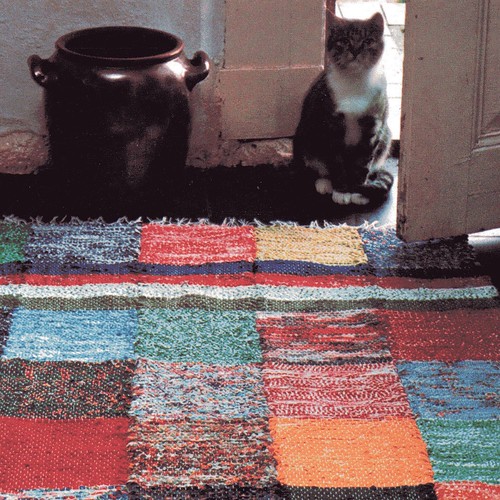
This shocking realisation dawned on me soon after buying a 1980 book, simply called Crafts, for 50p in Deptford market last Saturday, and seeing with my own eyes that the humble rag rug, staple of Fairtrade shops and student flats in the 80s, when made in the right colour combinations, could actually look amazing.
The patchwork number above is made out of fabric strips and hardwearing twine or string, woven into squares and sewn together. Fear not, you don't need to have a fancy room-sized loom – a basic £10 kids' tabletop one will do the job just fine... click here to find out exactly how to go about it.
 |
| Protest singer's pad? |
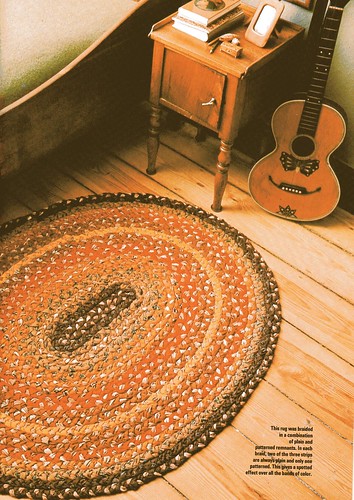
If you can't be bothered faffing about with a weaving loom, this lovely autumnal rug is made by braiding (plaiting) long strips of fabric together, winding the plait round in an oval or circular spiral and stitching each round to the previous one. Depending on the thickness of your fabric and the sturdiness of your sewing machine, you could probably zigzag the whole thing together on a machine. Easy peasy instructions for this one here.
It was a happy day when I stumbled upon my new favourite book. Craft (Book Club Associates, 1980) also features no fewer than 10 different belts to make, plus two hammocks and a picnic basket, which I look forward to sharing with you toute suite.
Last September, I posted 1950s Swedish Stitchery, about the beautiful embroidery in the book Hemslöjdens Handarbeten by Andra Delen.
Remember this?
 |
| A Pinterest favourite |
It's my most popular post by far, so thanks to everyone who has checked it out over the past year. Thumbing through the book once more, I remembered how spoilt for choice I was last time – there were so many lovely images I didn't have space to include – for instance, how did this amazing cushion not make it into the original post?
 |
| Blåsväder (Windy Weather) cushion |
I had a bash at translating the Swedish captions, but didn't get very far. Love the name of this one though. The hair!
 |
| Windy Weather (detail) |
I also found out that 'kudde' means 'cushion' and, hazarding a guess, 'mönster' means 'maker', but if there are any Swedish speakers reading this, I'd love some help piecing it together!
 |
| Beautiful washed-out pink |
I'd give anything to see this thing of beauty in colour – or even to be able to understand the caption...
 |
| Is it a bell or is it a tree? |
The birds on this Bird Wreath cushion go round in a circle, facing a green leafy garland. Just look at the detail in their wings:
 |
| Fåglar i Krans or Bird Wreath cushion (detail) |
The one thing I find frustrating about old craft books in general is the lack of colour plates. but colour printing was such an extravagance, it's actually surprising there is as much of it in this 1954 book as there is. There are loads more beautiful images in here though, even in black and white, so watch this space.
 |
| 1954 |
When I had time to have a good look through that haul of school library books I mentioned, the first thing that caught my eye was this splendid wallhanging.
And it struck me how rarely I see this type of textile art these days, although I do know for a fact that, as well as a mini one in my flat, there are a few cosifying the walls of a Swedish bakery in London
and a restaurant on the Isle of Mull in Scotland, like rugs on a wooden floor.
Appliquéd in linen and felt, rather than woven, the tapestry above is taken from a book with one of the best ever covers:
 |
| First English-language edition, 1970 (Batsford) |
And the back ain't bad either:
By and large consigned to dustbins and attics c1979, I think it's time for a wallhanging revival – and if you'd like to join me, I bring you (free) instructions for the wondrous wall warmer at the top of the post. You're welcome!
I thought my eyes were deceiving me when I happened upon a massive collection of 60s, 70s, 80s (and one 30s) craft books in my local bric-a-brac market yesterday. All from a school library in East Dulwich in south east London – and at £1 a pop, I bought as many as I could carry.
Sadly, for reasons of shelf space, I had to leave behind titles on macramé, plaiting, braiding, soft toy making and other skillz just a little out of the scope of my interests, but this little lot will keep me going for a while. Watch this space for some of the highlights.
 |
| 'Gay flowers on a trellis-work background' (detail) |
I was delighted when my colleague and neighbour* gave me this copy of Stitchcraft magazine, published in September 1934. It's hard to believe it's nearly 80 years old, especially as the iron-on embroidery transfer is still folded up inside, in pristine condition.
 |
| Autumn modes |
|
|
Several colourways are suggested for the Gay flowers design, but I'm ever so taken with these bright blooms on black linen, reminiscent of a design by Celia Birtwell.
The Stitchcraft people propose making your finished piece of embroidery into a cushion and runner set, a dressing table set or even a Radio Times or telephone directory cover (it says you need to make two phone book covers if you live in the London area – back in 1934 was there one directory for north London and another for south, or perhaps one for inner and one for outer London?)
 |
| Iron-on transfer, free with Stitchcraft, September 1934 |
The clever thing about the design of the transfer is that you can use sections, separated along the lines of the trellis, depending on the size of your project. I adore the flower with the sunray (/eyelashes) in its centre.
 |
| The 80-year-old transfer (detail) |
I'm desperate to put this truly vintage transfer to use soon, but it seems
such a shame not to keep it. Think I'd better trace it instead!
*(thanks Cleo!)
 |
| Micro mini and hooded caftans c1970. Far out! |
Just a quick one today, to say I'm posting a vintage sewing pattern a day over on Twitter, so if you fancy a daily dose of mod girl dresses, 60s maternity separates, micro-mini caftans, capes, and lots of culottes, follow me (@GYCMI via the link on the right)
 |
| Capes c1967 |
 |
| All that's missing is a bike chained to the railings |
I love the way blackwork, the monochrome counted-thread technique that was all the rage way back in fifteen-hundred-and-something, can look so modern, like a pen and ink illustration – and the patchwork effect of areas of different black and white geometric patterns side by side.
In Creative Needlecraft (Sundial Books 1979), author Lynette de Demme had the brilliant idea of depicting one house in blackwork (above) and in three other stitching techniques:
 |
| Colour embroidery, blackwork and a bit of applique |
To me, no73 looks just like some of the grand Victorian houses around Highgate, north London...
 |
| Gritty realism in applique |
I'd love to see these lined up together as if they were neighbouring houses on the same street.
 |
| Close up on the drawn fabric work version |
How nice the way the qualities of each technique emphasise different features of the building – the drainpipe, the balcony, the tiled front steps and three square decorative panels towards the top of the house.
If you'd like to sew your own house in black and white, you'll find a basic guide to blackwork here, and part 2 here.
 |
| All together now – awwww |
I was in a junk shop flicking through St Michael Handicraft Gifts (1978), my expectations way down low thanks to its soft-focus satin lavender bag and pot pourri cover, when my eyes fell upon this sleepy corduroy dog. I did a double take and then all but cried at how sweet he is. I know I must be getting sentimental in my old age, but come on LOOK AT HIM, he's even got a heart-shaped nose.
What more is there to say really, except I bet you want to find out how to make him, and have a look at the shape of that nose, so here's the pattern and the instructions. Night night then.
 |
| She's got a skirt pattern and she's going to use it |
While having my customary new-year clear-out, I came across the first sewing book I ever owned: My Learn To Sew Book. Why it had been put in storage I have no idea apart from the fact it's really tatty with a ripped and stained cover and half the pages are falling out. Anyway, what a blast from the past it is...
 |
| By Janet Barbour/illustrated by Belinda Lyon/published by Hamlyn, 1970 |
The projects are so familiar they're like old friends. Hello Lazy Daisy cat, Polly Dolly, hedgehog pin cushion and inhabitants of the primitive dolls' house:
 |
| (Not to scale) |
And a special welcome back for these stylish lion slippers, I missed you * scroll down for a link to the pattern*
 | | | | | | | |
|
| One of the mane things I like about this book |
These lovely illustrations made sewing look fun...
 |
| Best hairdos ever |
 |
| Ah the memories |
Sew (geddit), if you can see yourself lounging about with two lions on your feet, click here for the slippers pattern...
Or, if you are looking for something a little less ostentatious, here's how to make this marvellous money belt:
 |
| Put your money where your belt is |
Does this classic kids' book look familiar to you? Or is there another one that got you into making things? Let me know in the comments!
Wishing you all a very happy, healthy, crafty and prosperous 1958 2013! Thank you for reading – I'll be so 'glad if you can make it' for more of the same over the next 12 months and beyond – cheers!
|